
Walk down King Street in Newtown, Darling Street in Balmain or through The Rocks and the awnings overhead are doing more than keeping the rain off. Many are original or early fabric, decades or over a century old, and part of what makes those streetscapes heritage-listed in the first place. Repairing one is a genuinely different job to fixing a modern shopfront awning, and the difference isn’t just aesthetic. It touches the approvals process, the engineering, and the materials themselves.
Here’s what actually makes heritage awning repair harder, and why rushing it, or treating it like a standard repair, tends to cost more in the long run.
Working Within Heritage Controls, Not Just the Building Code
Most heritage shopfront awnings in Sydney aren’t on the State Heritage Register. They’re locally listed, either as an individual heritage item under Schedule 5 of the relevant council’s Local Environmental Plan, or simply by sitting inside a heritage conservation area. Either way, repair work usually needs to be assessed against the council’s heritage provisions before it can proceed, not just the structural and safety rules that apply to any awning.
In practice that can mean preparing a Statement of Heritage Impact to support a development application, since even changes that look minor from the footpath can affect a heritage item’s significance. There is some relief built into the system: the NSW Heritage Act sets out standard exemptions that let genuinely minor repairs to non-significant fabric proceed without a full heritage approval, provided the work does as little as possible and is carried out by people with the right skills and experience. The catch is that deciding whether a given repair qualifies as “minor” and “non-significant” is itself a judgment call, and getting it wrong can mean stop-work orders or having to undo completed repairs. We’ve covered the general council approval process in our council DA and permit guide for shop awnings.
Engineering an Old Structure to a Current Standard
Heritage awnings were built to the loading assumptions of their era, which were nowhere near as strict as AS/NZS 1170.2, the current Australian standard for wind actions on structures. A tied verandah from the 1890s or a cantilevered awning from the 1920s wasn’t designed with today’s wind loading, corrosion allowances or certification requirements in mind, which means a compliant repair often has to add structural capacity the original never had.
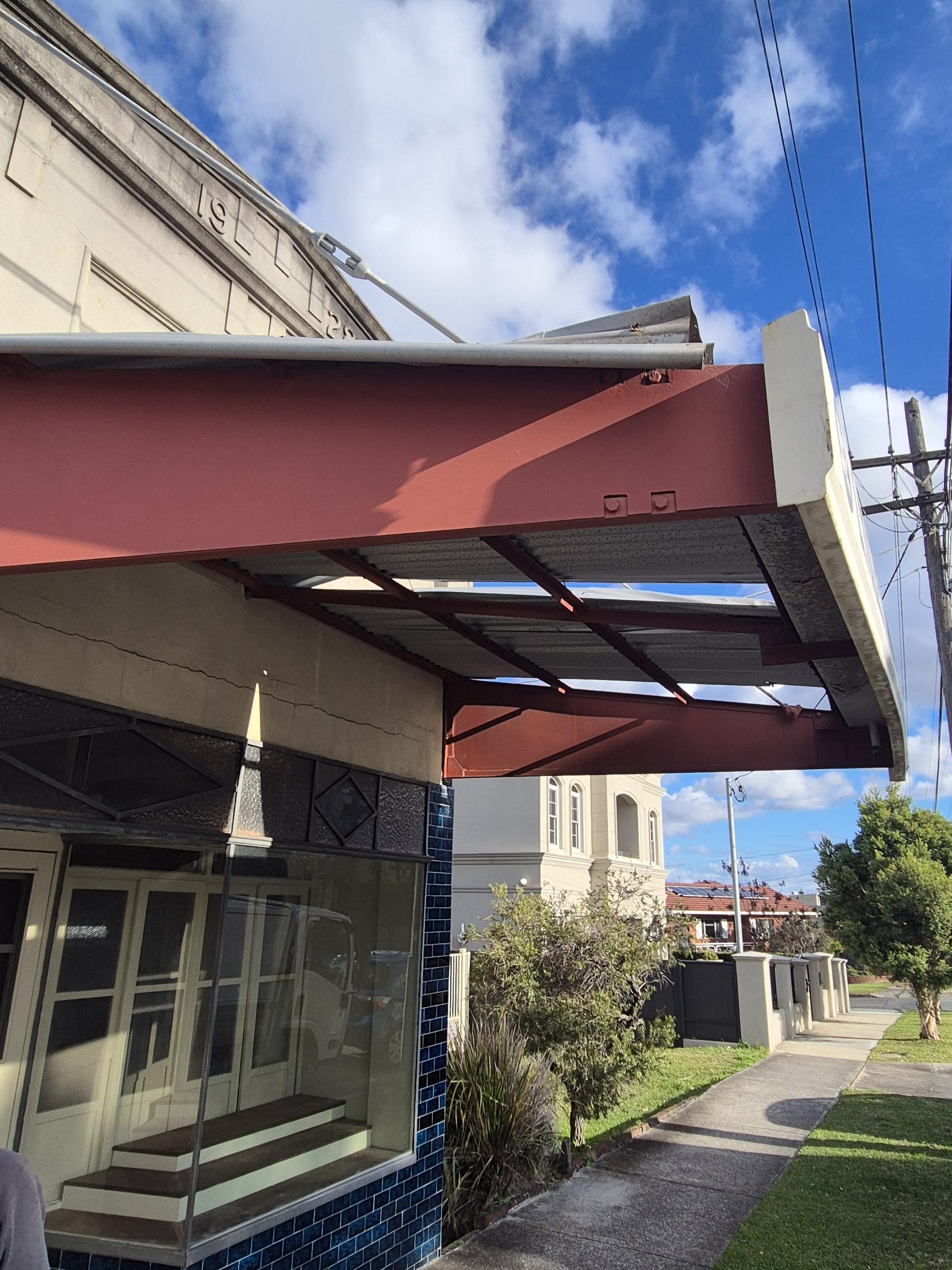
Corroded tie rods and anchor points are consistently the most safety-critical defect engineers find on older awnings, since anchorage failure is what actually lets a structure detach. The challenge is doing that structural upgrade without changing the profile, the fixing pattern or the visual character that made the awning heritage-significant in the first place. That balancing act is exactly why heritage awning repairs need a structural engineer who understands both AS/NZS 1170.2 and heritage fabric, not just one or the other.
What’s Usually Hiding Behind the Fascia
Heritage shopfronts commonly have timber framing concealed behind decorative fascias and soffits, and that framing is where rot and corrosion do their damage out of sight. It’s rare to open up a heritage awning and find only the problem you expected. More often there’s rusted structural steel, rotten timber bearers, or a previous repair that wasn’t done properly, sitting behind fabric that looked sound from street level.
Older sheeting and fascia materials can also turn out to contain asbestos, which changes the scope, cost and timeline of a project the moment it’s confirmed. We’ve written separately about what that process involves in our guide to asbestos in shop awnings. The practical implication for budgeting is the same either way: a heritage awning repair quote should always allow for what an inspection can’t see until the fascia comes off.
Matching Materials That Aren’t Made Anymore
Getting the structure right is only half the job. A heritage repair also has to match the original profile, material and detailing, whether that’s the curved bullnose roof of a Victorian-era shopfront, the timber fretwork and scalloped valance of a Federation awning, or the plain corrugated iron of an early colonial verandah. Our guide to heritage awning styles covers how to tell these apart, which matters because getting the style wrong on a repair is as visible as leaving the damage unrepaired.
Some of these components simply aren’t manufactured as standard stock anymore. Cast-iron lacework brackets and balustrades typically have to be reproduced from the original pattern, often recast in aluminium to reduce weight and long-term corrosion while keeping the original design intact. Corrugated roofing needs to match the original curvature and gauge rather than a modern off-the-shelf profile, and timber fretwork or turned posts usually mean custom millwork rather than a hardware-store replacement. None of that is work every awning contractor is set up to do.
Why It’s Worth Doing Properly
Streetscapes like Newtown’s King Street and Enmore Road hold their heritage value because hundreds of original awnings still read as a continuous run, not as isolated survivors. We’ve written in more detail about why Newtown’s heritage awnings matter, and the same logic applies anywhere a heritage conservation area depends on its shopfronts staying intact. A repair that ignores the regulatory, structural or material side of the job can end up costing more to fix twice, or put a heritage item’s council approval at risk entirely.
If you own or manage a heritage-listed shopfront, the safest starting point is an inspection from a team that has actually dealt with the approvals, the engineering and the materials before, not partway through a project. Get in touch to arrange an inspection and quote, or see our full range of heritage and commercial awning services for more on how we approach this kind of work.
Sources and Further Reading
- Heritage NSW, Standard Exemption 2: Repairs to non-significant fabric
- Minimum standards of maintenance and repair, NSW Environment, Energy and Science
- Gain exemption from requiring development consent for heritage works, City of Sydney
- Structural engineering advice on shopfront awnings, Sydney Engineers


