
Quick answer
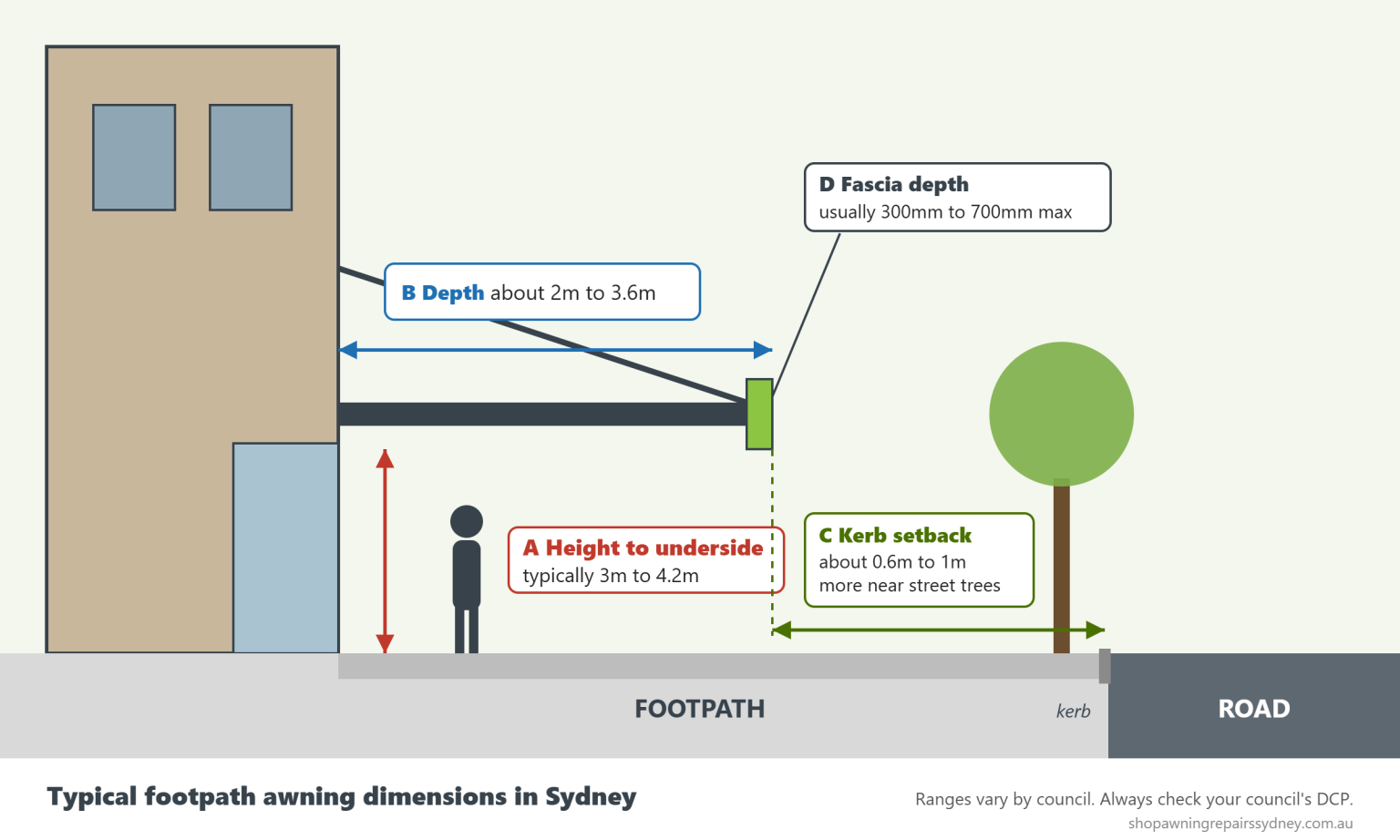
- Height: most Sydney councils want the underside of a footpath awning between about 3m and 4.2m above the footpath, matched to the awnings next door.
- Depth: typically 2m to 3.6m out from the building.
- Kerb setback: usually at least 600mm to 1m back from the face of the kerb, and more where there are street trees.
- Approval: the exact numbers come from your council’s Development Control Plan (DCP), and any structure over a public footpath also needs council consent under the Roads Act.
If you are planning a new shop awning, replacing an old one or have been told by council that yours needs to change, the first questions are usually the same: how high does it need to be, how far can it come out, and how close can it get to the kerb? This guide explains the typical rules across Sydney, with real examples from council planning documents, so you know what to expect before you start.
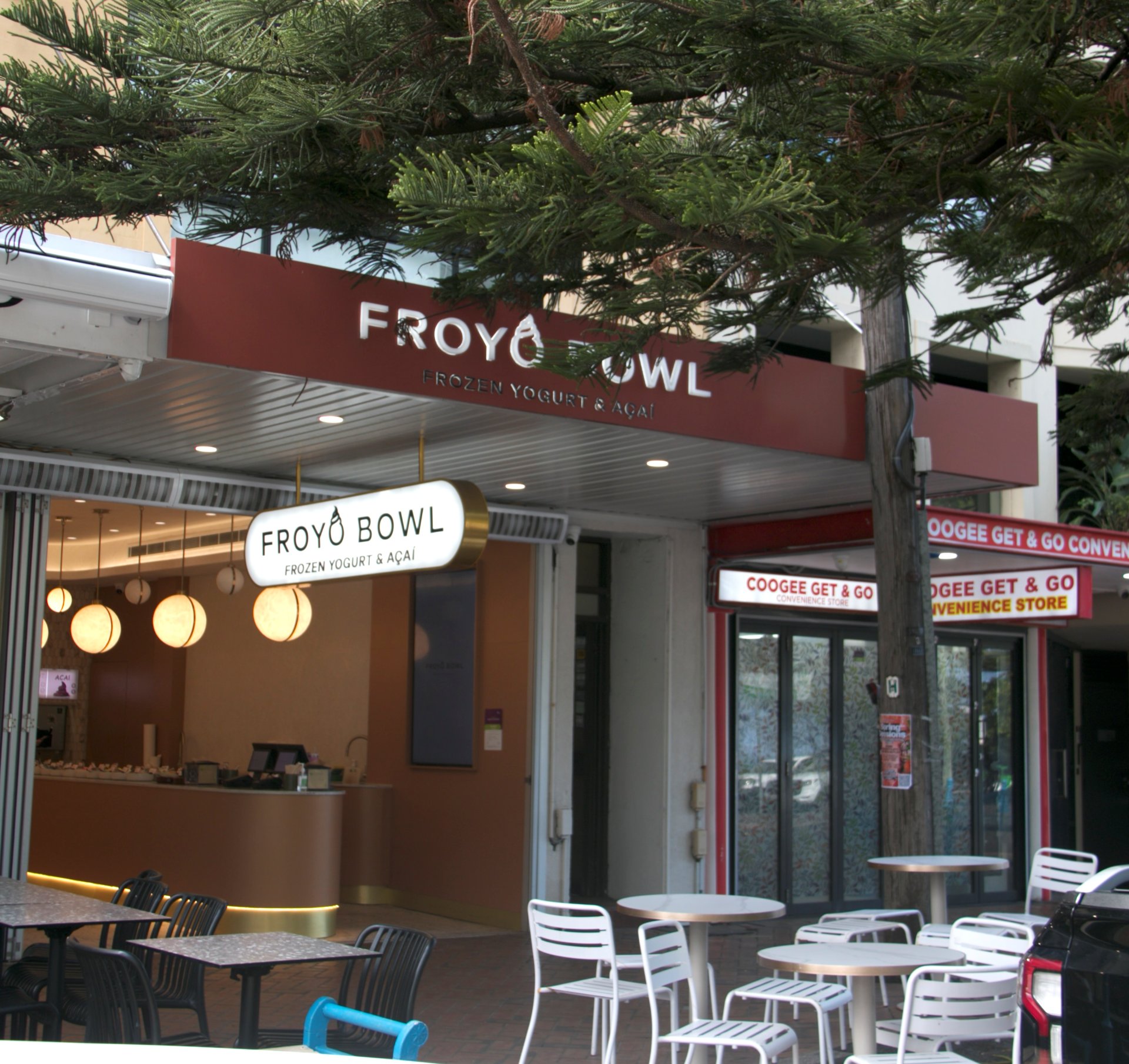
There Is No Single Rule for All of Sydney
Awning dimensions are not set by one state-wide rule. Each council sets its own controls in its Development Control Plan, and some councils set different controls for particular town centres or precincts. Because an awning over a footpath sits over public land, it also needs council consent under Section 138 of the Roads Act 1993, alongside any development approval for the building work.
That said, the numbers across Sydney councils are close enough that you can get a good idea of what will be accepted. The diagram below shows the four dimensions councils care about most.
How High Does an Awning Need to Be?
Councils set a minimum height so people can walk under the awning safely, and a maximum so the awning still gives real shelter from rain and sun. Some examples:
- City of Sydney: the Sydney DCP 2012 says the height of an awning may vary between 3.2m and 4.2m above the footpath, and it must line up with adjacent awnings.
- City of Parramatta: the Parramatta DCP 2023 controls for the Melrose Park precinct set a minimum soffit height of 3.3m and a maximum of 4.2m.
- Blacktown: Blacktown City Council’s awning application lists a minimum of 3m to the underside of the awning and a maximum of 5m above the footway.
On sloping streets, councils usually want the awning stepped rather than sloping with the footpath. The City of Sydney, for example, limits each step to 700mm. Matching the height of neighbouring awnings is just as important as the numbers, because councils want a continuous line of shelter along the street.
How Far Can an Awning Come Out Over the Footpath?
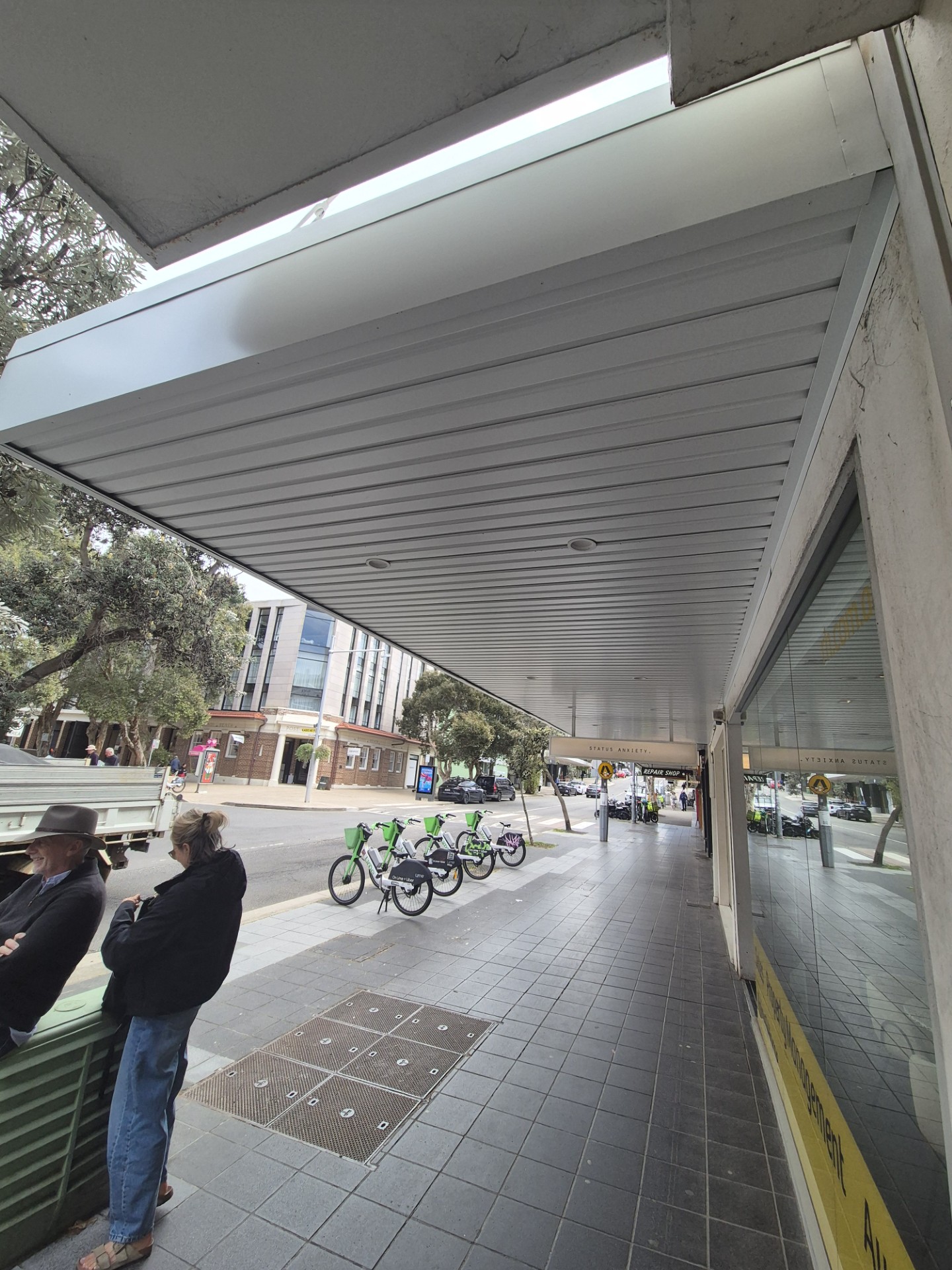
The depth of an awning, measured out from the building, decides how much of the footpath stays dry. Councils want awnings deep enough to give proper shelter but not so deep that they clash with the kerb, poles or trees.
- City of Sydney: awning width is to be between 2m and 3.6m, set to maximise weather protection and match the awnings next door.
- City of Parramatta (Melrose Park): a minimum of 2m deep, unless street trees are required.
How Close Can an Awning Get to the Kerb?
The gap between the front of the awning and the kerb protects the awning from trucks, buses and delivery vans in the kerbside lane, and leaves room for poles, signs and street trees. This is also where a lot of awning damage happens, which is why councils take it seriously.
| Council | Minimum kerb setback | Near street trees |
|---|---|---|
| City of Sydney | 1m from the face of the kerb | 1.5m from the face of the kerb |
| Parramatta (Melrose Park) | 600mm from the face of the kerb | 1.9m where street trees are required |
| Blacktown | 600mm from the kerb or road shoulder | Not specified in the application |
Both the City of Sydney and the Parramatta controls also say that cutting notches out of an awning to fit around trees or light poles is not acceptable. The whole awning is set back instead.
Fascias, Signs and Other Details
- Fascia depth: the City of Sydney caps the fascia at 700mm, with less than 350mm preferred. Parramatta’s Melrose Park controls ask for slim fascias, generally no more than 300mm.
- Under-awning signs: the Parramatta DCP 2023 requires under-awning signs to be at least 2.6m above the ground at every point.
- Gutters and lighting: the City of Sydney wants gutters hidden from the footpath, downpipes concealed in the shopfront, and lights recessed into the awning with no visible wiring.
- Corners: awnings on corner buildings are generally expected to wrap around the corner.
Do These Rules Apply to My Existing Awning?
Generally, the dimension rules are applied when an awning is new, fully replaced or significantly changed. Like-for-like repairs to an existing awning, such as replacing tie rods, soffit linings or roof sheeting, usually keep the awning’s existing size and position. Heritage awnings may also be treated differently, because councils often want the original form kept.
There are exceptions. If an existing awning is unsafe, too close to new poles or street trees, or in the way of street works, council can require it to be repaired, cut back or removed. Our guide to council awning safety orders explains how that process works, and our awning repairs page covers the most common fixes.
What Approvals Do You Need?
For a new or replacement awning over a footpath you will usually need development approval (a DA, or in some cases a complying development certificate) for the building work, plus Roads Act consent from council for the structure over the footpath. Our council approval guide for shop awnings explains the process step by step, and our local guides cover the rules for the City of Sydney, Parramatta, Waverley, Randwick and the Inner West.
Because the rules change between councils and even between streets, we check the controls that apply to your property before any design or quote is finalised.
Frequently Asked Questions
What is the minimum height for a shop awning over a footpath in Sydney?
It depends on the council, but most set a minimum of around 3m to 3.3m from the footpath to the underside of the awning. The City of Sydney allows between 3.2m and 4.2m.
How far from the kerb does an awning need to be?
Usually at least 600mm to 1m back from the face of the kerb, and more where there are street trees. The City of Sydney asks for 1m, or 1.5m near street trees.
Do I need council approval to replace my awning?
A full replacement or a new awning over a footpath generally needs development approval and Roads Act consent from council. Like-for-like repairs usually do not, but it is always worth checking first.
Planning a New or Replacement Awning?
We design, build and repair shop and street awnings across Sydney, and we know the council rules that apply in each area. Every job starts with a free on-site inspection and a clear written quote. Contact us to book a time, or see our commercial awnings page.