
When every supplier says they build to “commercial standard,” it can be hard to tell a properly engineered awning from a cheaper imitation until it fails a few years in. This guide covers what should be in a genuine commercial awning quote, the questions worth asking before you sign, and the red flags that separate a durable installation from a costly repeat job.
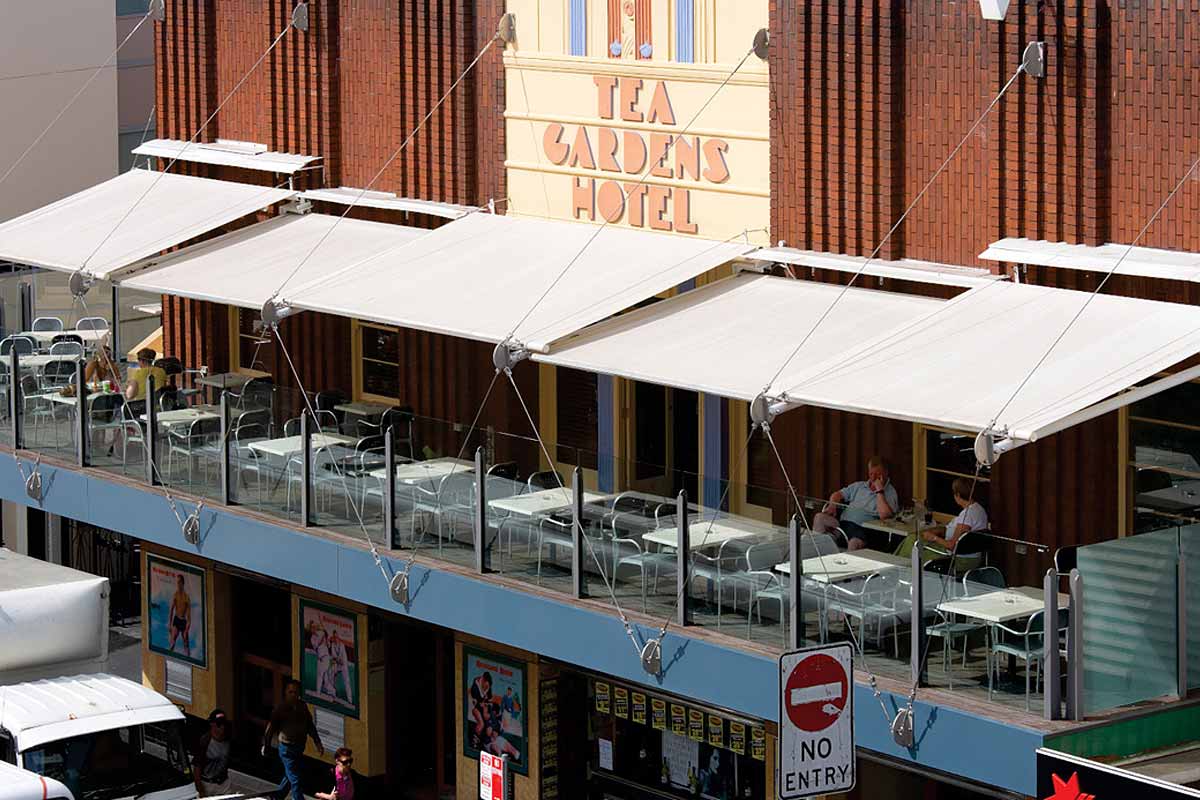
Retractable commercial awnings with tie-rod supports shading a rooftop dining terrace.
What “Commercial” Actually Means
A commercial awning is a different structure to a domestic patio shade. It is engineered to carry wind and dead loads calculated to AS/NZS 1170.2, fixed with tie rods or brackets rated for the span and site exposure, and built to survive years of coastal air, UV and public foot traffic without structural failure. That is why a genuine commercial quote costs more than a small residential job, and why comparing the two is not a fair comparison at all.
What Should Be in a Proper Written Quote
An itemised commercial awning quote should break down, at minimum: the frame material and grade (hot-dip galvanised steel versus aluminium, and why), the tie-rod or bracket system specified for your span, structural engineering and certification costs, council application costs if the awning projects over a public footpath, the cladding or fabric type, labour, an estimated fabrication and install timeline, and the warranty terms in writing. If a quote is a single lump sum with no breakdown, ask for one before comparing it against anything else.
Questions to Ask Before You Sign
A few direct questions early on save a lot of trouble later. Ask for the supplier’s current NSW builder’s licence number and class of registration. Ask for proof of current public liability insurance and the amount covered. Ask who provides the structural engineering certification and whether it is included in the price or billed separately. Ask whether the steel framing is hot-dip galvanised to AS/NZS 4680 or simply painted, since the two age very differently in Sydney’s coastal climate. And ask exactly what the workmanship warranty covers and for how long, in writing, not just verbally.
Red Flags: Why the Cheapest Quote Can Cost More
The lowest quote is often the lowest because something has been left out, not because the supplier is more efficient. Common shortcuts include lighter-gauge steel, skipping hot-dip galvanising in favour of paint, leaving structural certification out of the price and adding it later, and vague or verbal-only warranty terms. A cheap commercial awning that needs re-certification or re-fabrication within a few years almost always ends up costing more than paying for a properly specified one the first time.
Materials at a Glance
Hot-dip galvanised steel with adjustable tie rods suits long spans and high-density retail strips where wind load capacity matters most. Extruded aluminium is corrosion-proof and lighter, and suits coastal sites and medium shopfronts. Commercial-grade PVC and acrylic fabrics suit hospitality and outdoor dining awnings where visual impact and branding matter. Polycarbonate and metal decking suit arcades, laneways and entryways that need full weather protection with the option of natural light.
Getting an Accurate, Itemised Quote
Because so much depends on your building, span and site access, a reliable quote starts with a site assessment rather than a phone estimate. Shop Awning Repairs Sydney is a licensed NSW builder (Lic. 196494C) with $20M public liability insurance and over 25 years supplying and installing commercial awnings across Sydney. Every quote is itemised, every installation is backed by a workmanship warranty, and structural certification is handled in house. Get in touch for an obligation-free site assessment and quote.
Related Reading
Commercial Awning Supplier Sydney: Design, Build & Install
Shop Awning Installation Cost in Sydney: 2026 Price Guide
New Shop Awning Installation: A Step-by-Step Guide for Sydney
Or see everything we offer on our services page, covering repairs, maintenance and new installs.


