
If you have cleaned a shop awning and watched the mould or grime creep back within a few months, you are not doing anything wrong. You are treating a symptom. Cleaning removes what is already growing, but it does nothing about the conditions that let it grow back, and on most Sydney shopfronts those conditions never go away on their own. This guide looks at why awnings in this city keep getting dirty in the first place, what actually breaks that cycle, and when ongoing grime is telling you something more serious is going on underneath it.
Sydney Is Genuinely Hard on Awnings
There is a reason awning grime feels like a losing battle here. Sydney combines three things that mould, algae and general staining all thrive on: consistent humidity, a wet season that runs through summer and autumn, and salt-laden air across most of the metropolitan area, not just the coastline. A fabric or metal surface only needs to stay damp for a sustained period for growth to establish, and an awning is built to catch weather, which means it holds onto moisture longer than a wall or a window ever will.
None of this is a design flaw. It is simply what the job of an awning involves. The problem is that most cleaning advice treats the awning like a driveway, something you scrub occasionally and forget about, when the more useful comparison is a gutter: a structure that will always collect debris and moisture because of how it is shaped, and that needs a maintenance rhythm built around that reality rather than a one-off clean.
Mould, Mildew, Algae and Grime Are Not the Same Problem
Treating all discolouration the same way is the most common reason a clean does not last. Mould grows into the weave of a fabric awning and is genuinely difficult to remove once it has taken hold, since scrubbing the surface does not reach what is growing inside the fibres. Mildew sits on top of the fabric and lifts off far more easily. Algae is mostly a metal and painted-surface problem, showing up as a green or black film in shaded, damp corners of a steel canopy. General grime, soot, dust, and salt residue, is not biological growth at all, and responds to a simple wash that would do nothing for embedded mould.
Misreading which one you are dealing with leads to two common mistakes: using a harsh treatment on grime that only needed a rinse, or using a gentle wipe-down on mould that needed a proper soak-and-scrub cycle. Both waste effort and both make the next round of buildup worse, since a partially treated surface often provides a better foothold for the next growth cycle than one that was never touched.
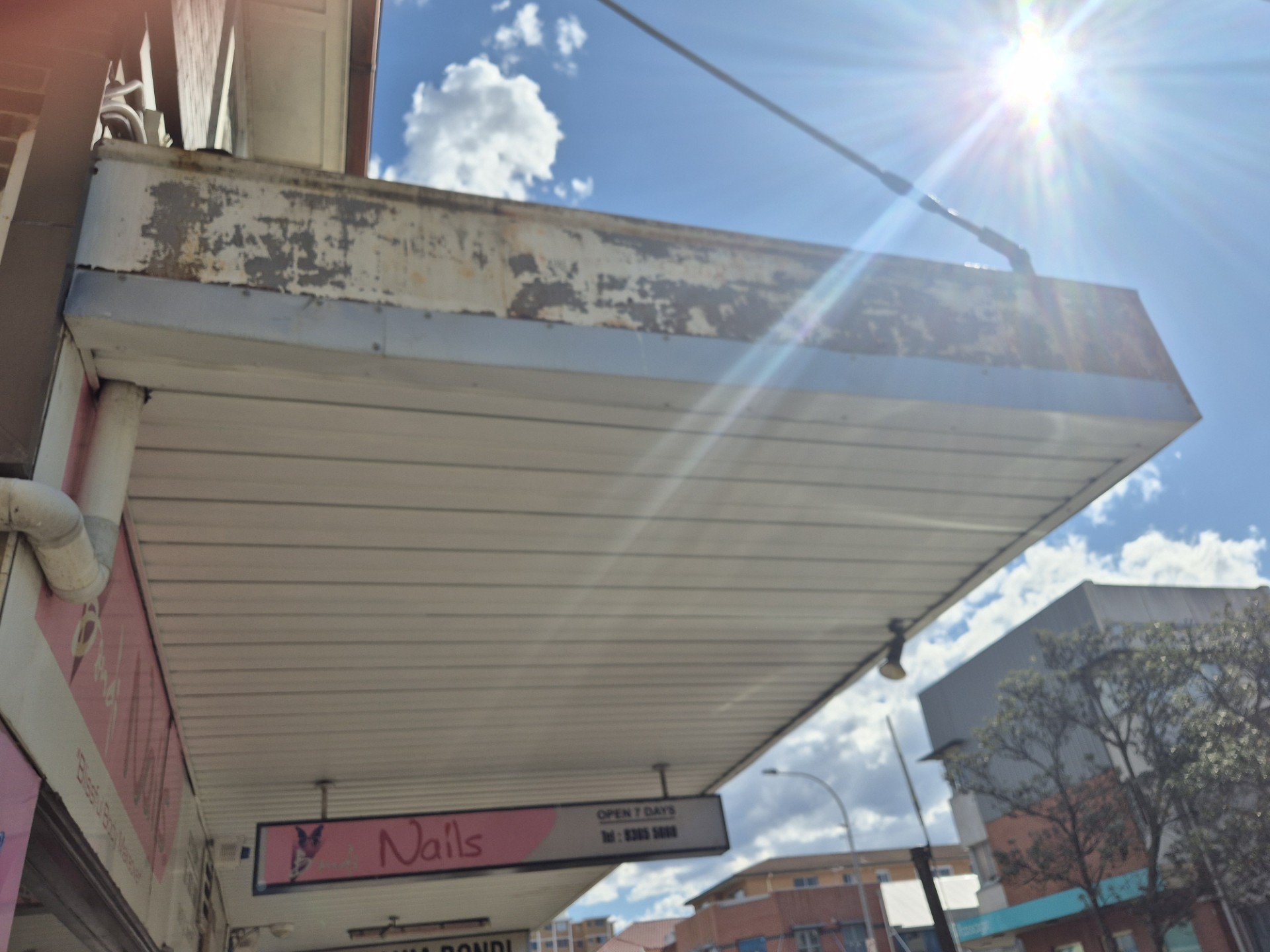
Where It Actually Hides, and Why That Matters
Growth does not spread evenly across an awning. It concentrates in specific spots: folds in the fabric where water sits after it should have drained, the underside of the canopy where sun never reaches, and shaded corners tucked behind a building’s own shadow for most of the day. These are the places that stay damp the longest after rain, and they are also the places people skip when cleaning from ground level with a hose or a long-handled brush, since they are the hardest to reach properly.
This is why a wipe-down of the visible, sun-exposed panels often looks like a complete clean while leaving the actual source of the problem untouched. If regrowth always seems to start in the same spot, that spot is very likely a drainage or airflow issue rather than bad luck, and it is worth having someone look at whether water is pooling there structurally, not just wiping it away again.
Design and Installation Play a Bigger Role Than Most Owners Realise
Two awnings in the same street, facing the same weather, can have completely different grime histories, and the difference usually comes down to how they were built. A canopy with a shallow pitch drains slowly and holds standing water after rain. One without adequate weep holes or drainage points traps moisture in the frame itself, where it cannot evaporate even on a dry, sunny day. A retrofit awning bolted onto an older shopfront without much thought for airflow behind the fabric will run damper than a properly specified new installation, regardless of how often it is cleaned.
If an awning is a repeat offender no matter how carefully it is maintained, the fix is sometimes not a better cleaning routine at all, it is correcting the drainage or ventilation problem that is causing the moisture to sit there in the first place. This is a conversation worth having with whoever installed or last serviced the awning, since it is often a straightforward adjustment rather than a full replacement.
Building a Routine That Actually Breaks the Cycle
A single clean is a reset, not a solution. The awnings that stay presentable long-term are the ones on a set schedule rather than a reactive one. As a general guide: awnings on coastal strips like Bondi, Coogee, Manly and Cronulla, where salt spray is constant, hold up best with attention every three to four months. Busy inner-city and cafe strips have a different driver, diesel exhaust and cooking grease rather than salt, but need a similar frequency for that reason. Awnings further inland, away from both salt air and heavy vehicle or kitchen exhaust, can often stretch to twice a year without issue.
Whatever the frequency, the routine matters more than the product. Brush off loose debris before any wet cleaning, since scrubbing over grit just grinds it into the fabric weave. Use a mild solution rather than anything bleach or solvent-based, which strips the protective coating on most awning fabrics and causes permanent staining rather than preventing it. And the step that gets skipped most often: let the awning dry completely, over several warm days if needed, before retracting or folding it away. Rolling up a damp awning is close to a guarantee that whatever was growing on it keeps growing inside the fold, out of sight, until it reappears worse than before.
Protective Treatments That Actually Extend the Interval
Cleaning removes what is there. A protective treatment is what changes how fast it comes back, and it is the step most awnings never get. A UV-stable fabric protectant or sealant applied after a proper clean and full dry meaningfully slows the next round of staining and mould growth, particularly on the shaded sections that never get natural UV exposure to help keep growth in check. On metal frames, a wax-based protective coating applied after cleaning does the same job for algae and general grime, and has the added benefit of protecting bare or touched-up metal from the next stage of corrosion.
None of this is a permanent fix, Sydney’s climate will always win eventually, but it is the difference between cleaning every three months and cleaning every three months while also watching the same corner get worse regardless. Treated awnings hold their appearance for meaningfully longer between services, which in practice means less total time spent on maintenance over a year, not more.
When Grime on Metal Is Actually a Warning Sign
Algae and staining on a fabric awning are almost always cosmetic. Grime and streaking on a metal frame deserve a closer look, because what looks like surface dirt is sometimes early corrosion presenting the same way. A greenish or dark film that will not lift with a normal wash, particularly around welds, brackets, or anywhere two metal surfaces meet, can be the first visible sign of rust starting underneath a coating rather than sitting on top of it. This is worth checking properly rather than assuming another scrub will fix it, since it is the same early-stage pattern we cover in more detail in our guide to rusted tie rods on shop awnings, where corrosion spreads for years before it becomes an obvious structural problem.
If you are already up there cleaning, it costs nothing extra to check the fixings, welds and tie rods for early signs of this while you are at it. Catching it early is a quick fix. Catching it after it has spread through a structural member usually is not, and our guide to assessing repair versus replacement covers how to tell the difference.
What Letting It Go Actually Costs
A mouldy or grimy awning is not just a cosmetic issue, though the street-presence cost alone is real. A worn, dark-streaked canopy reads as a neglected shopfront to anyone walking past, regardless of how well the business behind it is actually run. Beyond appearance, embedded mould that is never properly treated does eventually degrade fabric integrity, shortening the awning’s usable life and bringing the replacement conversation forward by years compared to a well-maintained equivalent. And as covered above, grime that masks early corrosion on a frame is not a cosmetic delay at all, it is a structural one, and the kind of delay that tends to get more expensive the longer it sits.
DIY Cleaning Has Real Limits
Most routine cleaning is fine to handle yourself. What is not worth doing yourself is working at height above a public footpath, which most shop awnings are, since a dropped tool or a bumped ladder is a real liability question, not a hypothetical one. A pressure washer is the other common shortcut that causes more problems than it solves: it looks efficient, but on most fabric awnings it forces water into seams and stitching that were never designed for that kind of pressure, and can void whatever manufacturer warranty is left on the fabric.
If a fabric section has been properly hand-cleaned and the mould is still visibly embedded rather than lifting, that is usually a sign the fabric itself has reached the point where our repair-or-replace guide applies, not a sign the cleaning was done wrong. It is also a good moment to combine the clean with a proper inspection, since whoever is already up there looking closely at the fabric is well placed to check the frame and fixings at the same time.
Keeping Your Awning Looking the Part
Breaking the mould-and-grime cycle on a Sydney shop awning is less about finding a stronger cleaner and more about understanding why your specific awning gets dirty the way it does, then building a routine and a set of protective steps around that. If you want the practical step-by-step for the clean itself, our awning cleaning guide covers the process for both fabric and metal in detail. If you would rather not deal with the ladder, the liability, or guessing whether this round of grime is just grime, our team handles cleaning and inspection together, so nothing gets missed. Our free 60-second awning safety check is a fast way to find out where yours currently stands, and if a clean is not going to be enough on its own, get in touch for an inspection and a written quote.

2 Responses