
Walk under most Sydney shop awnings and you will not think twice about what is actually holding them up. The steel tie rods running from the awning frame back into the building’s fascia or masonry do their job quietly, for years, without a second glance from anyone underneath. That is exactly the problem. Corrosion does not announce itself. It builds slowly inside a joint, behind a bracket, under a coat of paint, until the rod that has been carrying real structural load for a decade or more is a fraction of the steel it used to be.
We inspect and repair tie rods across Sydney every week, and rust is consistently one of the most common reasons an awning ends up unsafe. It is also one of the easiest problems to catch early, and one of the most expensive to ignore. This guide looks at why tie rods rust, what the early signs actually look like, what NSW law expects of you as the owner, and what a proper repair involves.
What a Tie Rod Actually Does
A shop awning is not simply bolted to the wall and left to hold its own weight. Most cantilevered and hybrid awning designs rely on a system of tie rods: steel rods running at an angle from the outer frame of the awning back to an anchor plate fixed into the building’s masonry or structural fascia. The tie rod works in tension. It is doing the job of stopping the awning tipping forward under its own weight, under wind load, and under the weight of any water that pools on the roof sheeting after rain.
Anchor plates spread that load across the masonry so a single point of brick or render is not carrying the entire force on its own. Between the rod, the anchor plate, and the fixings holding it all together, this is genuinely a structural system, not a decorative bracket. When any one part of it fails, the load has to go somewhere else, usually onto components that were never designed to carry it.
Why Tie Rods Rust So Fast in Sydney
Steel corrodes when it is exposed to moisture and oxygen, and Sydney shopfronts get a particularly harsh combination of both. Salt-laden air rolling in from the coast, even well inland, speeds up the electrochemical reaction that turns steel into rust. Awnings in Bondi, Manly, Coogee, Cronulla and other coastal suburbs tend to show corrosion years earlier than equivalent awnings further inland in places like Parramatta or the Hills District, simply because of how much salt is in the air they sit in day to day.
Add Sydney’s humid summers, the runoff from awning roof sheeting that channels rainwater straight past the rod and anchor point, and decades-old fixings that were never upgraded, and you have ideal conditions for corrosion that most owners never see coming until it is well advanced.
A lot of the tie rods we replace were never protected properly to begin with. Plain mild steel with a coat of paint over the top looks fine for the first few years, but paint is not a corrosion barrier once it is scratched, and once rust starts under a painted surface, it spreads underneath the coating where nobody can see it. Mixing metals is another common issue. When a stainless fixing is used against a galvanised plate, or a rod is fitted with the wrong grade of bolt, the dissimilar metals set up galvanic corrosion that eats away at whichever metal is less noble, often far faster than ordinary weathering would.
Galvanising slows this process down significantly, and stainless steel, particularly 316 grade, resists it best of all in a coastal environment. But even the best-protected tie rod is not immune. It is a matter of when, not if, and the timeline depends heavily on how the awning was originally built, how close it sits to the coast, and how well water actually drains away from the fixings.
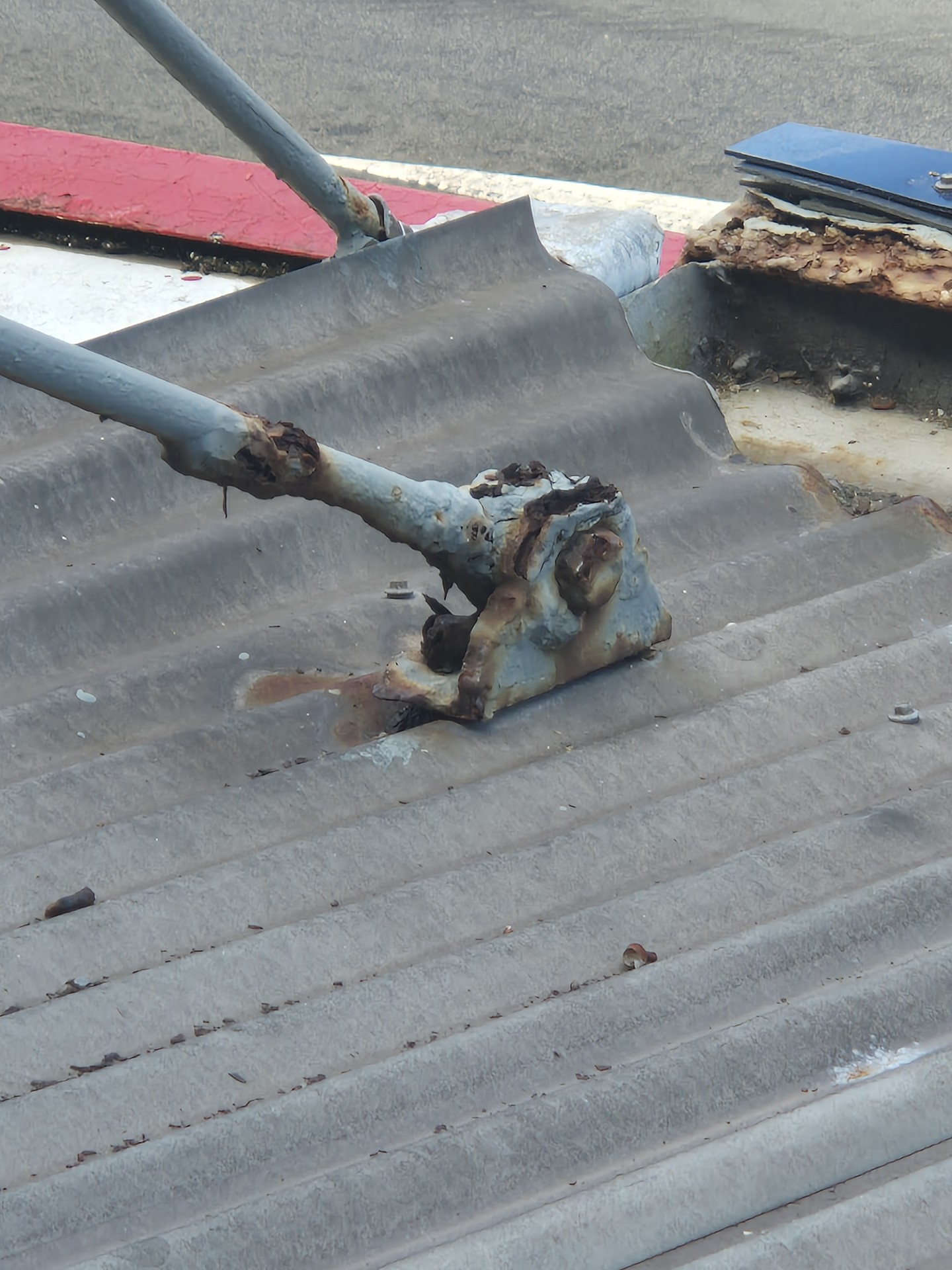
The Warning Signs You Can Actually See
Most owners do not notice a rusting tie rod until the awning itself starts to look wrong. A few things are worth checking for next time you walk past your own shopfront:
- Rust streaks bleeding down the fascia or brickwork directly below where a tie rod connects, even if the rod itself is out of sight.
- Visible orange or brown corrosion on any exposed section of rod, turnbuckle, or anchor plate.
- A slight sag or dip in the awning line that was not there before, particularly if it is worse on one side than the other.
- Movement or flex in the awning during wind that feels more pronounced than it used to.
- Cracking or crumbling render or mortar around the anchor plate, since a corroding rod can expand slightly and push against the surrounding masonry.
Any one of these on its own is worth a closer look. A few of them together usually means the corrosion has already progressed past a surface-level problem.
Why a Rusted Tie Rod Is More Than Cosmetic
It is tempting to treat surface rust as a maintenance item to get to eventually. The risk is that a tie rod does not fail gradually the way fabric wears out or paint fades. Steel loses cross-sectional area as it corrodes, and once enough of that area is gone, the remaining steel can fail suddenly under load, typically during the exact conditions it is meant to resist: a storm, strong wind gusts, or the extra weight of pooled rainwater sitting on the awning roof.
A tie rod failure does not just mean a wonky awning. It can mean a section of awning frame dropping onto the footpath below, with all the safety and liability consequences that come with a structure failing over a public walkway. In NSW, responsibility for a shop awning’s safety sits with the property owner, not the council. If someone is injured under an awning that has failed due to a known or discoverable defect, the owner is the one exposed, not the local council that never inspected it.
What NSW Law Actually Expects From You
Most Sydney councils require that shop awnings over ten years old be inspected by a structural engineer registered on the National Engineering Register, with a written report confirming the awning, its supporting elements, and its drainage are structurally sound for at least the next five years. That report typically needs to be lodged with council within a set period after the inspection, and failure to comply can carry fines of up to $6,000.
We have seen how this plays out in practice. One of our clients personally raised a concern with a council ranger about the poor condition of a nearby awning. It took roughly two months from that first report for the ranger to actually inspect the awning and issue a formal repair order. Council enforcement is not instant, and it will not necessarily catch every unsafe awning before it becomes a problem. Waiting for a ranger to force the issue is a slow and unreliable way to manage a structural risk that is entirely within your control to fix earlier. It is also worth remembering that once council does get involved, you are working to their timeline and their notice period, not your own.
If you are not sure whether your awning has had a compliant inspection recently, our guide on council approval and permits for shop awnings and our piece on navigating council awning safety orders both cover what happens if council steps in first.
Repair or Replace: What the Fix Actually Involves
Not every rusted tie rod needs full replacement. The right fix depends on how far the corrosion has progressed:
- Surface corrosion on an otherwise sound rod can sometimes be treated, primed, and recoated, provided an inspection confirms the underlying steel has not lost significant thickness.
- Localised replacement of an individual rod, turnbuckle, or anchor plate is the most common repair we carry out, particularly where the rest of the frame and fixings are in good condition.
- Full masonry tie and anchor plate replacement is needed where corrosion has spread into the fixing point itself, or where the original installation used an inadequate anchor for the load involved.
Where we replace tie rods, we generally recommend upgrading the material rather than matching what was there originally, especially for anything within a few kilometres of the coast. Hot-dip galvanised steel is a solid, cost-effective standard for most inland and suburban jobs. For exposed coastal locations, or for anyone who wants the longest possible service life, 316-grade stainless steel costs more upfront but avoids the galvanic corrosion issues that come from mixing metal grades, and holds up substantially longer in salt air.
Every tie rod and anchor plate replacement we carry out is signed off with structural certification from a licensed engineer, with a written report you can hand straight to your council, insurer, or body corporate. That is the same report that satisfies the ten-year inspection requirement covered above, so a repair job and a compliance inspection can often be handled in the same visit.
The Cost of Waiting
A tie rod and anchor plate replacement is a minor job compared to what it is protecting against. Set against the cost of a full awning rebuild, footpath and fascia repairs after a structural failure, or the legal exposure of an injury claim, catching corrosion early is by far the cheaper outcome in every scenario. It is also far less disruptive: a planned repair can usually be done without closing your shopfront, while an emergency callout after visible sagging or a partial failure often cannot.
Preventing the Next Rust Problem
A tie rod replacement is a good moment to fix the conditions that caused the corrosion in the first place, not just the symptom. A few things make a real difference to how long a replacement lasts:
- Making sure roof sheeting and guttering actually drain away from tie rod and anchor points, rather than channelling water directly onto them.
- Choosing galvanised or stainless fixings consistently, rather than mixing metal grades at the same connection point.
- Keeping an eye on paint or coating condition on any exposed steel, and touching up scratches or chips before they become a way in for moisture.
- Getting a professional visual check every year or two even outside the mandatory ten-year structural inspection, since catching surface rust early is far cheaper than replacing a failed rod later.
Our awning maintenance guide goes into more detail on a practical inspection routine you can run yourself between professional visits.
Book an Inspection Before It Becomes a Bigger Problem
Rusted tie rods are one of the few awning problems that genuinely get more expensive and more dangerous the longer they sit. If you have not had your tie rods and anchor points checked in the last few years, or if you have noticed any rust streaks, sagging, or movement in your awning, it is worth booking an inspection before it becomes a council matter, or worse, a safety incident. Get in touch for a free quote and engineer-certified inspection anywhere across Sydney, from the Eastern Suburbs to the Northern Beaches, Inner West, Sutherland Shire, and Parramatta.
See our full range of repair and maintenance services for what else we cover beyond tie rod repairs.
