
Not every shop awning in Sydney is fabric. Walk along almost any older commercial strip and you will find galvanised steel, Colorbond and pressed metal awnings that have been shading shopfronts for decades. They are tougher than canvas in a lot of ways, but metal brings its own set of problems: rust, galvanic corrosion, and a structural issue that often goes unnoticed until it shows up as a crack in the fascia above the door.
Here is what actually goes wrong with metal awnings in Sydney, what to look for, and when a repair is enough versus when the whole structure needs replacing.
What Counts as a Metal Awning
“Metal awning” covers a few different builds, and the material affects both how it fails and how it gets repaired:
- Galvanised corrugated steel: the classic curved or flat sheet roofing seen on Victorian and Federation-era shopfronts, usually supported by steel or timber rafters.
- Colorbond steel: a more modern, factory-coated steel sheeting, common on awnings built or replaced from the 1980s onward.
- Aluminium-framed awnings: lightweight and naturally corrosion-resistant, often used where weight on the supporting wall is a concern.
- Pressed metal: decorative sheet metal, historically zinc or galvanised iron, pressed into patterns and used on heritage-listed and character shopfronts.
- Steel-framed awnings with sheet cladding: a structural steel frame carrying a metal roof, common on larger commercial and hospitality awnings.
Each of these ages differently, and mixing metals in the one structure, steel brackets under an aluminium roof for example, introduces a corrosion risk that a single-material awning does not have.
Why Metal Awnings Rust and Corrode in Sydney
Sydney’s coastal air is the main driver. Salt in the atmosphere speeds up oxidation wherever metal and moisture meet, which is why awnings in the Eastern Suburbs and other coastal strips tend to show rust years before an equivalent structure further inland.
A second, less obvious cause is galvanic corrosion: when two different metals are in contact with each other in the presence of moisture, one corrodes faster to protect the other. A steel bracket fixed directly to an aluminium frame, or steel fasteners through Colorbond sheeting where the coating has worn through, both set this up. The fix is usually to isolate the two metals with a non-conductive gasket or membrane rather than simply replacing the corroded part, otherwise the same failure happens again.
Coating breakdown is the third factor. Galvanising, powder coating and paint all wear thin over time, especially at fold lines, fixing points and anywhere water pools instead of draining. Once the protective layer is gone, the base metal is exposed and corrosion accelerates.
The Rendered Fascia Crack Most Owners Miss
A lot of older metal awnings have a rendered or concrete fascia band along the front edge, hiding the structural steel brackets or lintel that actually carry the load. It looks like a plain, solid strip of render, so a crack running along it gets written off as normal building movement.
Often it is not. When the steel embedded inside that render starts to corrode, it expands as it rusts, sometimes to several times its original volume, and that expansion pushes outward on the render surrounding it. The result is a crack that follows the line of the hidden steel, and eventually the render can spall away completely, exposing the corroded metal underneath. This is a structural warning sign, not a cosmetic one: it means the steel doing the actual work of holding the awning up is already compromised.
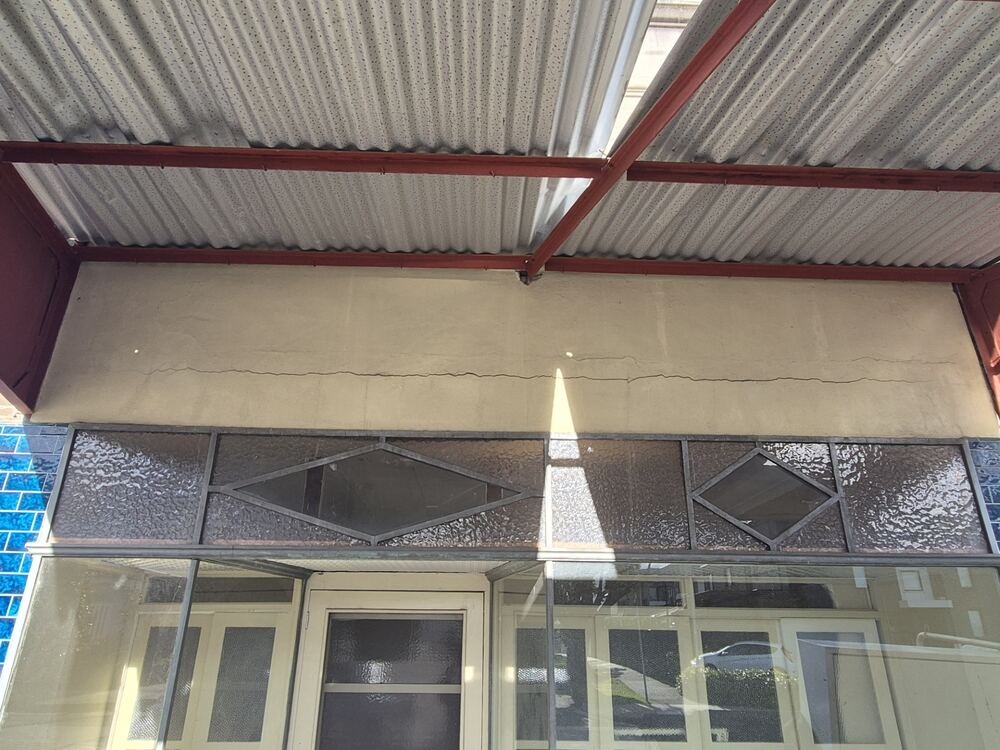
Patching the crack without addressing the corrosion behind it does not solve anything. The steel needs to be exposed, treated or replaced, and the render made good around it, otherwise the same crack reopens within a season or two.
Repair or Replace? What We Assess
Not every rusty metal awning needs to come down. What decides the outcome is usually:
- How far the corrosion has spread: surface rust on roof sheeting is a straightforward clean, treat and recoat job. Corrosion that has eaten into a load-bearing bracket or rafter is a structural repair, not a cosmetic one.
- Whether the frame is still sound: sheeting can often be replaced on its own if the underlying steel or aluminium frame has held up.
- Age and original build quality: some heritage awnings were overbuilt by the standards of the time and have plenty of life left once corrosion is dealt with. Others were minimal from day one and are closer to end of life.
- Drainage: an awning that has been holding water against the metal for years will keep corroding at the same points even after a repair, unless the drainage problem is fixed at the same time.
As a rule, we would rather repair a sound structure properly than push for a full replacement it does not need, but a structure with corrosion through a primary load-bearing member is not something to patch and hope.
Council Compliance for Metal Awnings
Most Sydney councils treat awnings over a footway as structures the owner is responsible for maintaining, and several run active inspection programs. A common requirement is that awnings more than 10 years old be assessed by a structural engineer at least once every 5 years, with a report confirming the structure, its supports and its drainage are all sound. Council awning safety orders reference engineering practice notes covering exactly this kind of inspection.
In practice, enforcement is not instant. We have seen a council ranger take around two months from a reported issue to actually inspecting an awning and issuing a formal repair order. That is not a reason to wait for a complaint before acting. It is a reason to get ahead of it: a rendered fascia crack or visible rust patch found and fixed on your own terms is a lot cheaper and less disruptive than the same issue found by a ranger and turned into a compliance order with a deadline attached.
If you manage a shopfront with a metal awning showing rust, a cracked fascia, or you are simply not sure how old the structure is or when it was last inspected, get in touch for an assessment. We will tell you plainly whether it is a straightforward clean and recoat or something more structural, and what a council would expect to see.
Related Reading
Or take a look at our full range of services, covering everything from repairs to new builds.
For steel-frame and larger commercial installations, see our commercial awnings page.